Using Crumblytics
Learn From Every Sourdough Bake
A good loaf deserves more than a photo and a vague memory that “the dough felt better this time.”
Crumblytics keeps the important details of every bake together: ingredients, timings, proofing stages, temperatures, ratings, notes, and photos.
Instead of reconstructing an earlier bake from memory, you can return to the full record, compare it with other loaves, and make your next adjustment with more confidence.
The goal is not to turn home baking into a laboratory. It is to help you remember what happened and recognise useful patterns that would otherwise be easy to miss.
Your Baking History in One Place
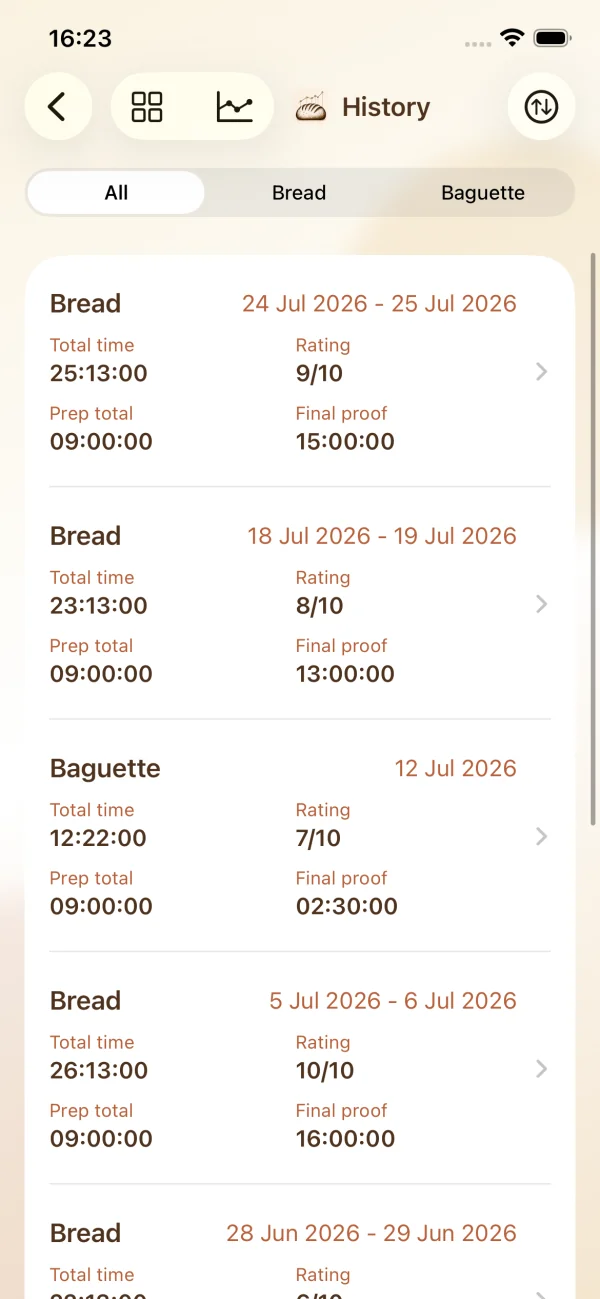
Every completed bake becomes part of your Crumblytics history. The history view gives you a quick overview of previous breads and baguettes without requiring you to open every entry.
The overview can include details such as:
- Date of the bake
- Total process time
- Total preparation time
- Final-proof duration
- Overall rating
You can filter the list by bread type, which makes it easier to compare similar bakes rather than mixing every recipe and process together.
This can answer practical questions quickly:
- How long did my previous loaf take?
- Which bake had the longer final proof?
- Was that baguette rated better than the previous one?
Open a Bake and See the Full Story
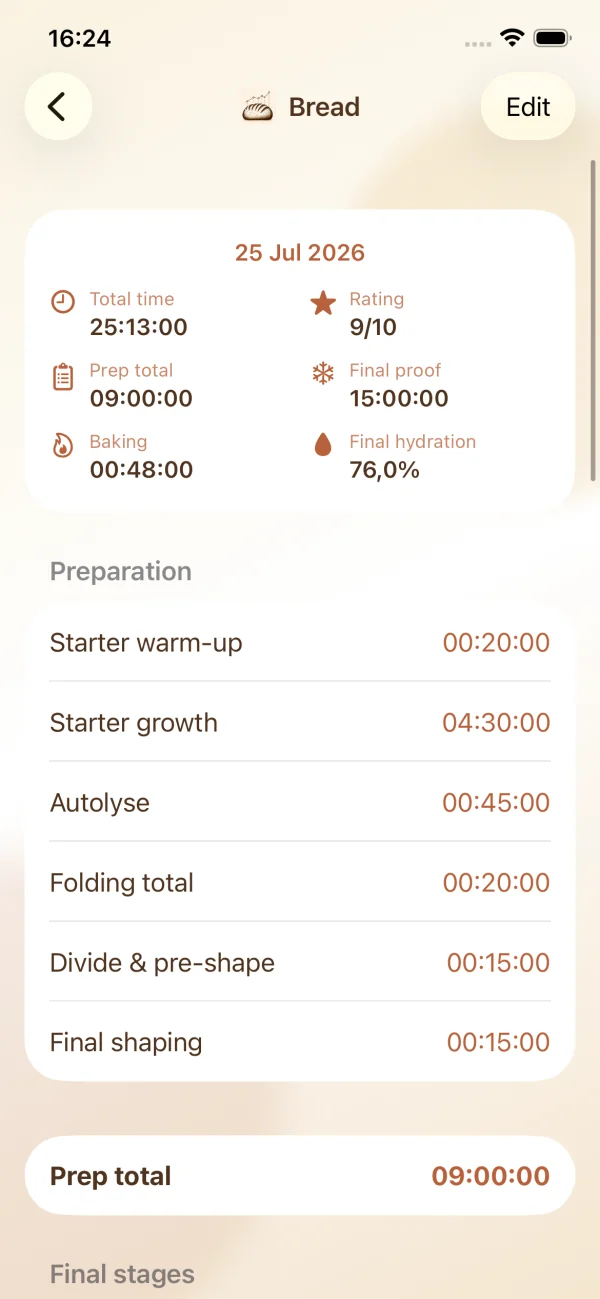
A single rating rarely explains why a loaf turned out well. Crumblytics preserves the wider context behind the result.
A detailed bake record can include:
Process Details
- Starter warm-up
- Starter growth
- Autolyse
- Folding
- Dividing and shaping
- Final-proof stages
- Baking phases
Recipe and Result
- Ingredients and flour choices
- Hydration
- Recorded temperatures
- Starter ratios
- Ratings
- Notes
- Photos
Two loaves can use the same flour and hydration but behave very differently because of starter activity, room temperature, fermentation time, shaping, or proofing.
Keeping these details together makes those differences easier to understand later.
Review Each Stage, Not Only the Final Result
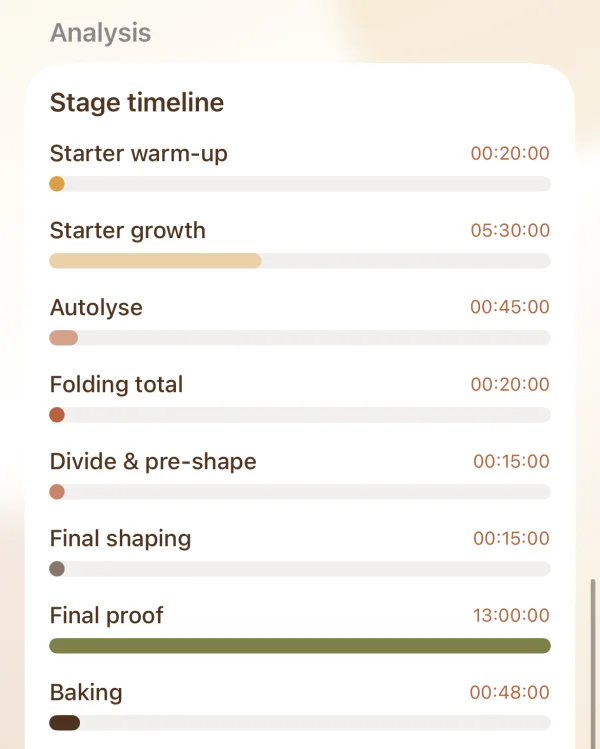
The same total process time can hide very different baking decisions.
One loaf may have spent longer in final proof. Another may have needed more time for starter growth or bulk fermentation. Looking only at the total duration would make those bakes appear more similar than they really were.
The stage timeline shows how the process was divided between:
- Starter preparation
- Fermentation
- Dividing and shaping
- Final proof
- Baking
This gives you a clearer picture of the process behind the result and helps you identify which stage changed between two bakes.
Record How the Bread Actually Turned Out
Numbers are useful, but bread is not judged by a stopwatch alone.
Crumblytics lets you record qualities such as:
- Overall rating
- Taste
- Crumb structure
- Crust
- Rise
- Starter growth
You can also add notes for observations that do not fit neatly into a score.
Example Result Notes
- The crumb was slightly tight.
- The flavour improved after the cold proof.
- The crust was darker and crisper than last time.
Example Process Notes
- The dough spread during scoring.
- The starter reached peak earlier than expected.
- The dough felt stronger after the final fold.
These observations become much more valuable when they remain connected to the exact flour, hydration, fermentation, and proofing used for that bake.
Build a Visual Journal with the Moodboard
Sometimes the fastest way to compare two bakes is simply to look at them.
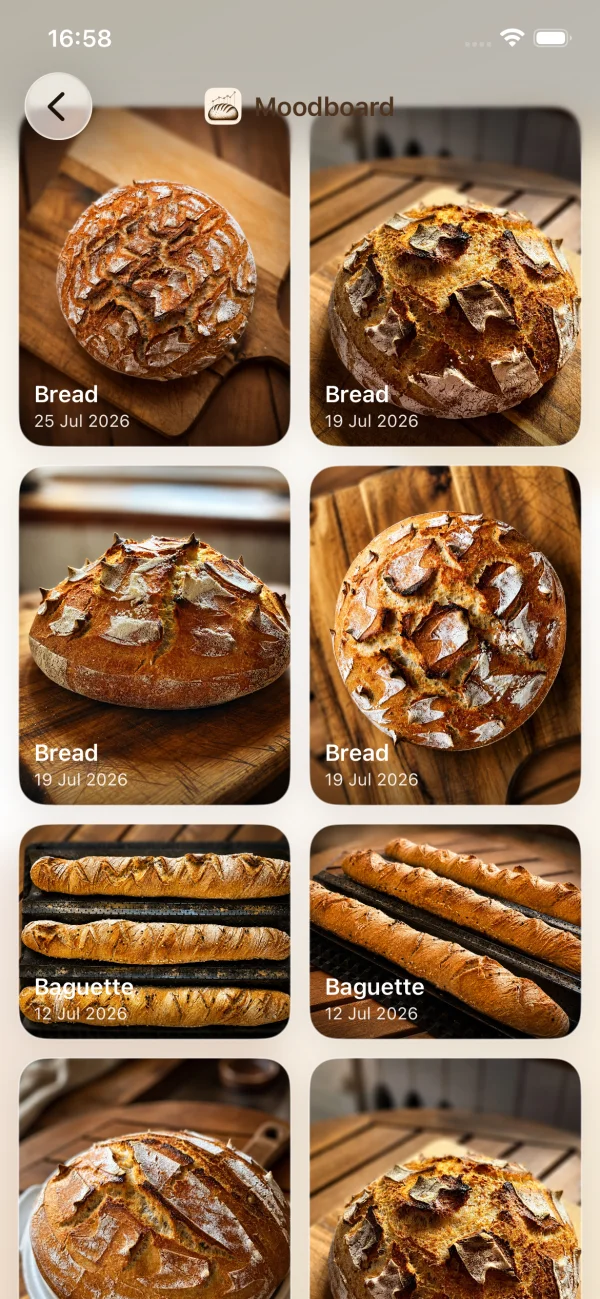
The Moodboard brings your saved bread photos together in a visual gallery. Each image remains associated with its loaf and date, making it easier to revisit:
- Crust colour
- Scoring patterns
- Oven spring
- Loaf shape
- Consistency between bakes
- Changes in your technique over time
Over time, the Moodboard becomes a visual record of your progress. It can include successful loaves as well as experiments that taught you something useful.
A photo may remind you that a highly rated bake had better expansion, a darker crust, or a more balanced shape. You can then return to the corresponding history entry and review the process behind it.
Analytics Built from Your Own Bakes
Once you have recorded several loaves, Crumblytics can summarise your baking history.
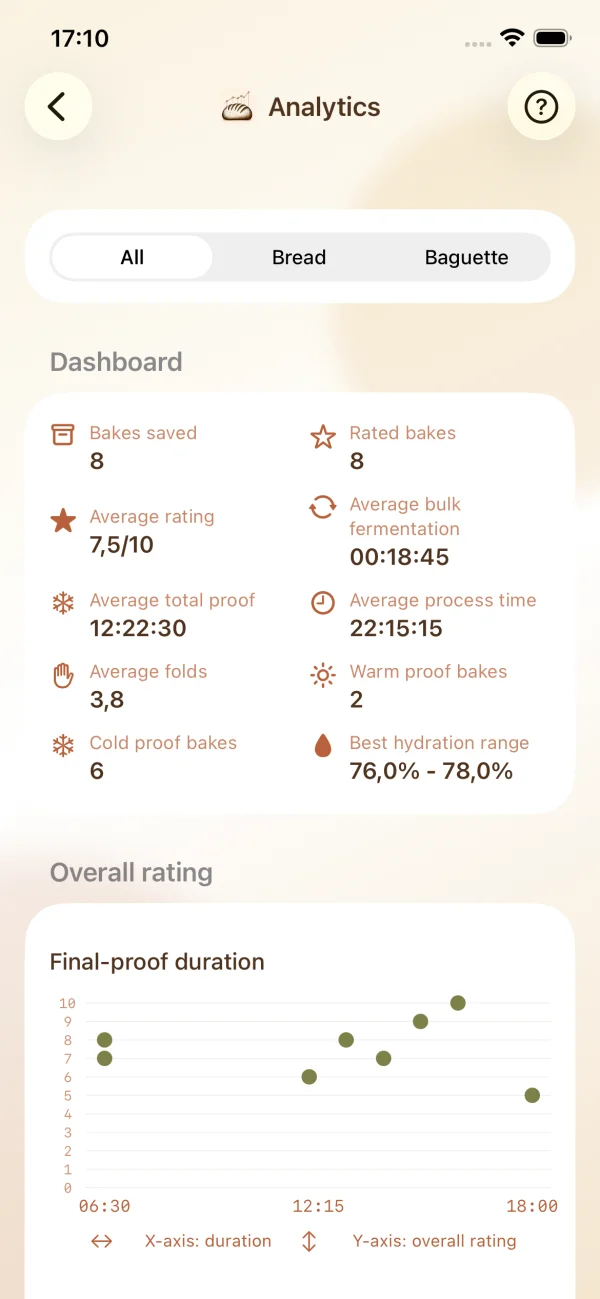
The analytics dashboard can show information such as:
- Number of saved bakes
- Number of rated bakes
- Average overall rating
- Average fermentation time
- Average proofing time
- Average total process time
- Average number of folds
- Number of warm and cold proofs
- Hydration ranges connected with stronger results
These values are based on your own baking history rather than a universal sourdough timetable.
That distinction matters. A four-hour fermentation may work beautifully in one kitchen and poorly in another. Flour, starter, temperature, schedule, and handling all influence the process.
Crumblytics helps you study what has worked for you.
Spot Patterns Across Time, Temperature, and Technique
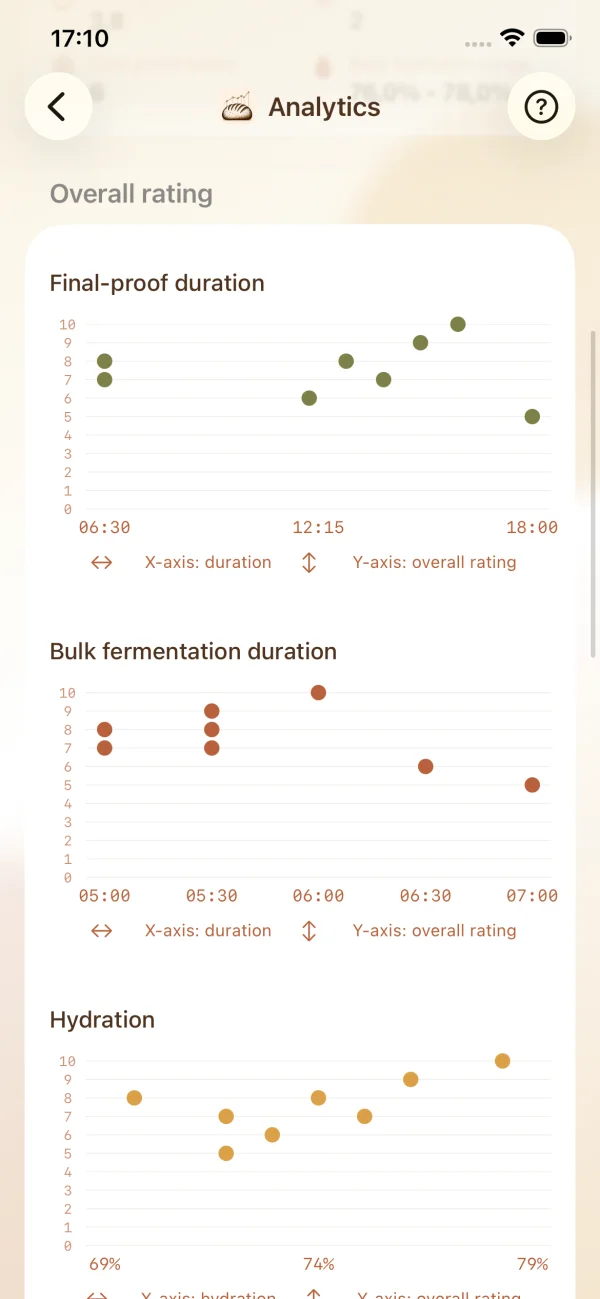
Correlation charts let you compare recorded variables with your ratings and starter-growth results.
Examples include:
- Final-proof duration and overall rating
- Bulk-fermentation duration and rating
- Hydration and rating
- Starter-rise temperature and starter growth
- Starter-growth duration and result
- Starter-to-flour ratio and starter growth
You can also choose your own X-axis and Y-axis variables for a custom comparison.
These charts can help you ask more useful questions:
- Do my best loaves usually have a longer cold proof?
- Does this flour perform better at a lower hydration?
- Is my starter more reliable near a particular temperature?
- Do additional folds improve the result?
Compare the Flours You Actually Use
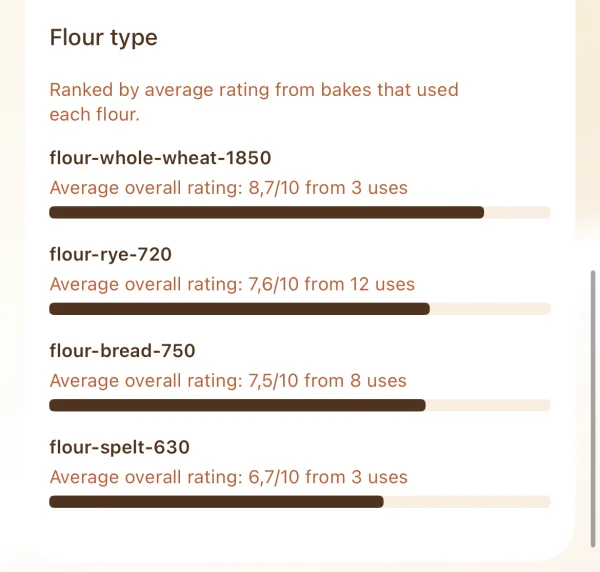
Different flours can behave differently even when the recipe appears similar.
Crumblytics can group recorded bakes by flour and show their average ratings. This may help you identify which flours have produced the most consistent results in your own baking.
The highest-ranked flour is not automatically the objectively best flour. The number of recorded bakes, recipe, hydration, starter, and technique still matter.
The comparison instead helps answer a personal and practical question:
Which flour has worked best in the loaves I have actually baked?
Compare a Bake with Your Average
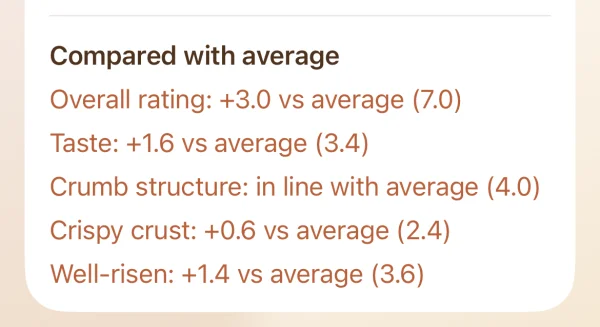
A single bake becomes more informative when you can place it beside your previous results.
Crumblytics can highlight how a loaf compared with your average ratings in areas such as:
- Overall result
- Taste
- Crumb structure
- Crust
- Rise
Improvement does not need to happen in every category at once. One loaf may have:
- Better flavour but a tighter crumb
- Stronger rise but a weaker crust
- Improved structure after a different proof
- A similar result from a shorter process
Instead of reducing the entire bake to one number, the comparison shows where it improved and where it still differed from your usual result.
Make the Next Bake More Intentional
Your history becomes most useful when it helps you decide what to do next.
- Review a similar previous bake.
- Look at its recipe, timings, temperature, and result.
- Choose one meaningful variable to adjust.
- Keep the rest of the process reasonably consistent.
- Record the next bake.
- Compare the new result with your history.
Changing one meaningful variable makes the next comparison easier to understand. Changing flour, hydration, temperature, folding, and proofing simultaneously may produce a different loaf, but it will be harder to know which change mattered.
The purpose is not to discover a universal perfect formula. It is to understand how your starter, flour, kitchen, schedule, and technique work together.